April 2, 2026. AquaChile, Lipigas, and Transportes GLA signed an agreement to incorporate Bio-LNG into salmon transportation, an initiative that will allow the salmon farming industry to move towards logistics with a lower environmental impact.
The announcement was made at AquaSur 2026, where the companies confirmed they will begin using Bio-LNG as fuel in the trucks that transport AquaChile products, marking another step in the transition to more sustainable fuels for heavy transport.
This initiative continues the collaborative work the three companies have been developing to reduce emissions in their logistics operations. At the beginning of 2025, AquaChile, along with Lipigas and Transportes GLA, began operating a new fleet of LNG-powered trucks to transport its products. With this agreement, progress will now be made toward the use of Bio-LNG, a 100% renewable and carbon-neutral alternative, compatible with the infrastructure and equipment currently operating on liquefied natural gas.
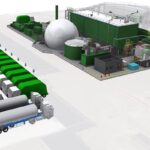
The Bio-LNG used in this operation is produced by Lipigas at its plant inaugurated in November 2025 in the Ñuble region, the first facility of its kind in Latin America. This plant generates renewable liquefied natural gas through a purification and cooling process of biogas derived from agricultural waste, integrating a circular economy model that contributes to the decarbonization of heavy transport.
According to company figures, in a fleet of 270 trucks, the use of Bio-LNG avoids more than 35,500 tons of CO2 per year, in addition to reducing particulate matter emissions by 96%, decreasing nitrogen and sulfur oxides by 85%, and lowering noise emissions by up to 50%. These benefits are equivalent to taking more than 6,000 cars off the road or planting 38,000 trees.
The fuel will be available at Lipigas’ network of LNG truck refueling stations, an infrastructure that, since 2021, has connected Chile and Peru between Lima and Puerto Montt, forming a green corridor that facilitates logistics operations with a lower environmental impact.