
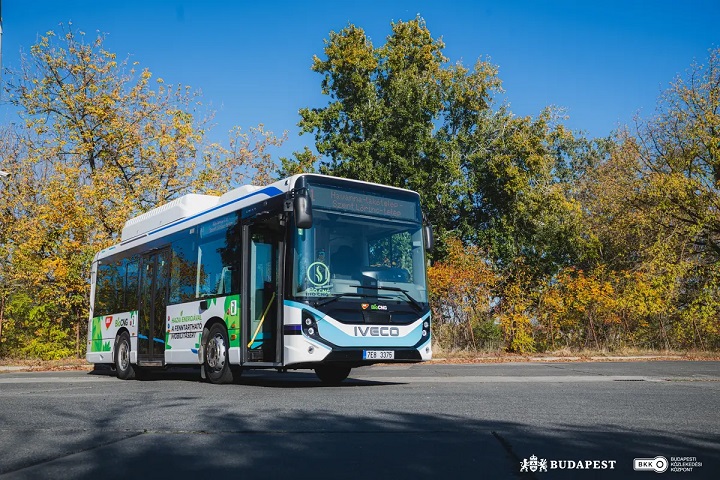
November 12, 2026. Budapest’s first bus powered by biomethane (Bio-CNG), a renewable fuel, has been unveiled and will begin trial operations on route 132E. The bus was presented at a press conference held in front of MOL’s headquarters in the Hungarian capital.
Speaking at the event, Ambrus Halász, Head of Corporate Communications at MOL Group, welcomed the opportunity provided by Budapest’s transport companies, BKK and BKV, to test a biomethane-powered bus in the capital. “The commissioning of our first biomethane facility in Szarvas on October 14 marks an important milestone for us. It means that, going forward, we will also be able to supply the market with Bio-CNG,” he said.
One of the main drivers behind this strategy is European Union regulation, including the Clean Vehicles Directive. Under the directive, more than half of the buses purchased and put into public transportation service between 2026 and 2030 must meet clean vehicle requirements. Compressed natural gas (CNG), alongside electric and hydrogen-powered vehicles, qualifies as a compliant technology.
Taking total life-cycle costs into account, biomethane can be competitive with diesel. It also produces lower nitrogen oxide and particulate emissions. In addition, it offers significantly quieter operation than diesel-powered vehicles while providing a comparable driving range and competitive refueling times.
According to Ádám Bodor, CEO of BKK (Budapest Transport Center): “Transportation is still responsible for thirty percent of Budapest’s carbon dioxide emissions, with public transportation accounting for three percent of the total. Although most Budapest residents travel by metro, tram, or trolleybus, approximately 1,100 of the city’s 2,300 public transportation vehicles are buses, most of which run on diesel. Replacing these with electric models therefore represents one of the biggest challenges.”
He added that while the transition to electric vehicles is important, other technologies could also contribute to more sustainable transportation. In his view, around 300 buses will need to retain internal combustion engines over the long term to ensure reliable service in Budapest. Nevertheless, testing new technologies and the latest versions of existing ones remains essential.”
BKV currently operates 37 buses powered by compressed natural gas, although these will gradually need to be replaced due to their age, he added.