
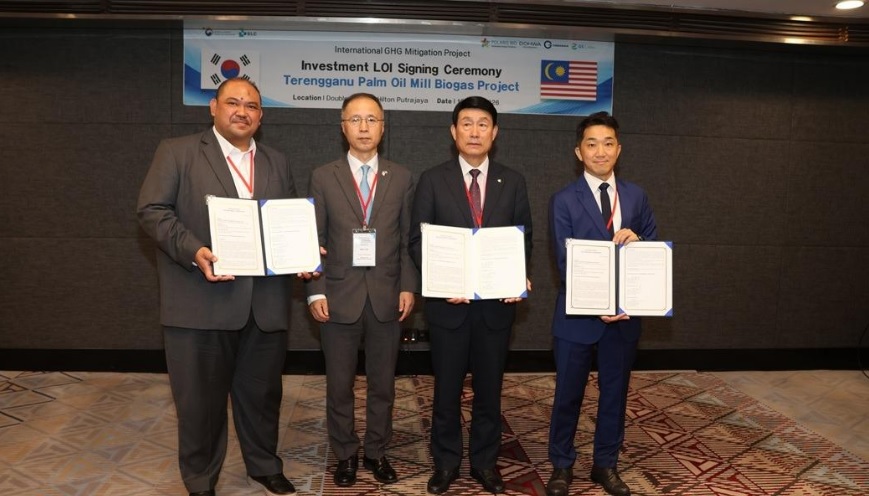
June 16, 2026. Malaysia and the Republic of Korea have further strengthened their strategic partnership in renewable energy through the exchange of a Letter of Intent (LOI) for the Terengganu State Palm Oil Mill Biogas Upgrading Project, an initiative that will convert palm oil industry waste into Bio-Compressed Natural Gas (Bio-CNG).
Supported and coordinated by the Malaysian Bioeconomy Development Corporation (Bioeconomy Corporation), the project brings together South Korean renewable energy companies Polaris Bio Co., Ltd. and Sudokwon Landfill Site Management Corporation (SLC), together with Malaysian technology partner MTC Orec Sdn. Bhd., to unlock the commercial potential of palm oil industry waste as a high-value clean energy source.
In the long term, the initiative aims to establish more than 20 biogas upgrading facilities based on Palm Oil Mill Effluent (POME) across Malaysia. The Terengganu project is expected to be among the earliest developments under this initiative and will serve as a reference model for future projects nationwide.
Through this facility, biogas generated from POME, a liquid by-product of palm oil milling operations will be processed and upgraded into Bio-CNG, a cleaner renewable fuel suitable for use in transportation, industrial applications and electricity generation.
By harnessing biotechnology to convert palm oil waste into a high-value energy resource, the project supports Malaysia’s transition towards cleaner energy while enhancing national energy security through reduced reliance on fossil fuels.
Nationwide implementation of the initiative is expected to reduce greenhouse gas emissions by up to 384,000 tonnes of carbon dioxide equivalent (CO₂e) annually, contributing to Malaysia’s energy transition agenda and sustainable development goals.