
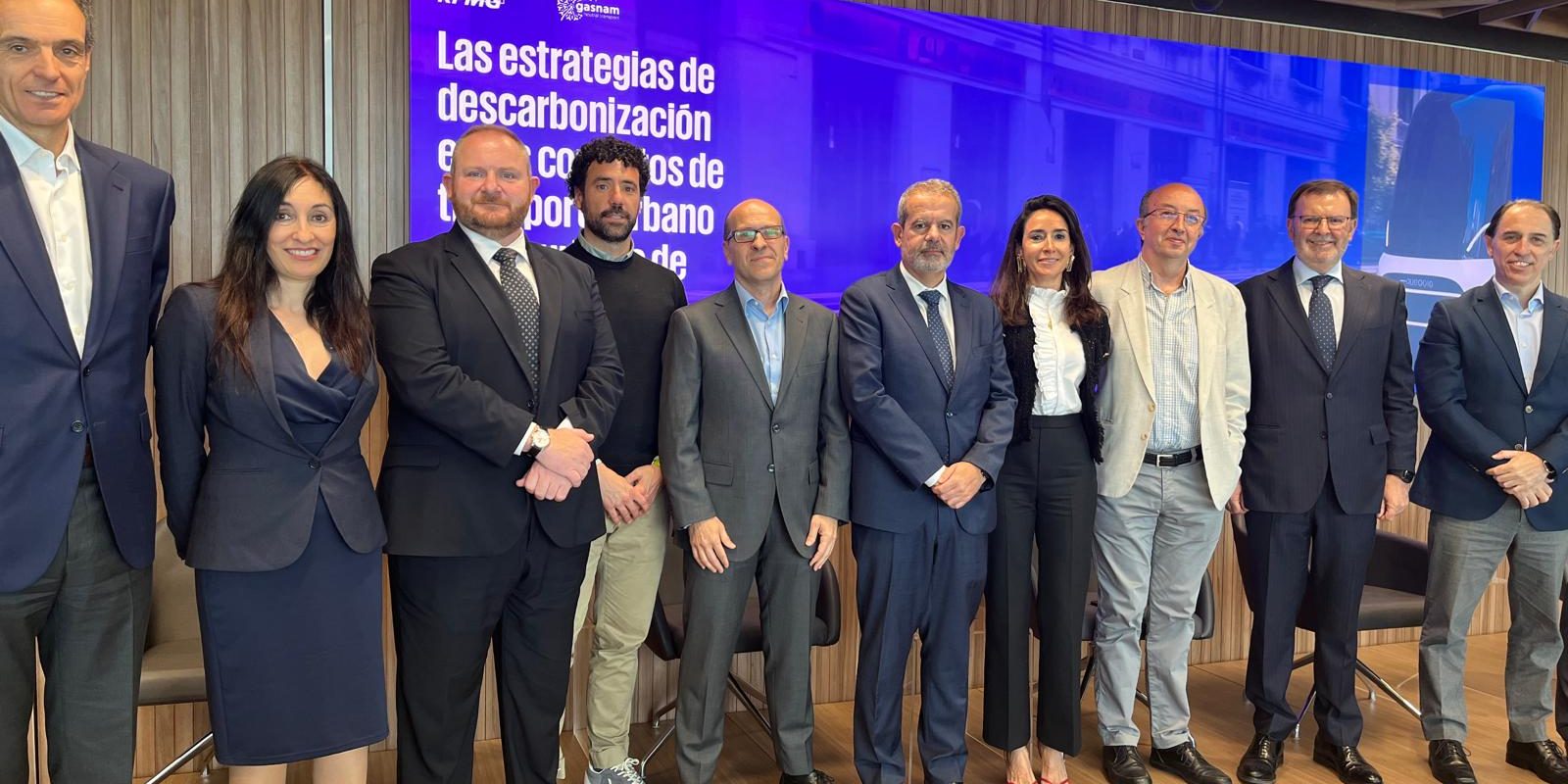
May 22, 2024. Experts from the transport and energy sector have called for greater technological neutrality in passenger transport tender contracts so that operators can freely choose the most convenient technology in each case depending on the type of operation they realize the vehicle and its technical feasibility and maturity in the market. This would be the main message that has been repeated at the conference “Decarbonization strategies in urban and interurban passenger transport contracts”, an event organized by Gasnam-Neutral Transport, in collaboration with CONFEBUS and KPMG, which has brought together almost a hundred representatives of public organizations and private companies.
During her intervention, the General Secretary of Gasnam-Neutral Transport, Eugenia Sillero, stated that “the challenge of decarbonizing transport is of such magnitude that it requires the contribution of all clean energies and a technological neutrality approach. Bus fleets that use CNG have the opportunity to be carbon neutral immediately, thanks to biomethane and synthetic gas, solutions that provide high autonomy, low refueling times and economic competitiveness given that they do not require modifications to the engine or refueling infrastructure. Sillero added that “producing a fuel from the waste generated in our own country allows us to guarantee compliance with the sustainability and emissions reduction objectives established by the RED III Renewable Energy Directive and represents an opportunity to move towards a sustainable circular economy”.
The President of CONFEBUS, Rafael Barbadillo, added that all propulsion technologies are necessary for the decarbonization of the activity (electricity, biomethane, renewable fuels or hydrogen) “because there is no single solution that covers the different types of transport services of road travelers (urban, suburban, medium distance and long distance), so technological neutrality is essential and must be accompanied by the corresponding aid or tax incentives so that the sector can address this important technological change.” Likewise, he has pointed out that it is necessary to generate a stable regulatory framework that facilitates public-private collaboration, promoting rate review formulas that provide for all the technologies used in contracts.
Vehicle manufacturers, transport operators and energy companies have stated that the key to a just transition is that technologies are sustainable, which is why there is a need for technological neutrality. The Director of IVECO BUS, Fabrizio Toscano, spoke along this line, pointing out that “CNG and biomethane are already a reality in our cities and continue to be valid alternatives for the decarbonization of interurban transport; hydrogen will be the next step, but for this it will need institutional support.”
The sector also calls for greater government incentives in the adoption of more sustainable transport solutions. This aid should not only be for the operators, but also for the Public Administrations themselves that own the services and are obliged to assume, through the concessionaires, the extra costs derived from the regulation aimed at reducing emissions in the mobility of people, stated the head of Expansion and Innovation at Grupo Ruiz, Albino Pérez, who added that “incentives are essential due to the high investment costs required by new energy technologies.”
In addition, the session included the participation of the head of Energy of the Commonwealth of the Region of Pamplona (MCP), Javier Zardoya, who presented the success story of Pamplona’s municipal transport. This pioneering entity in 2014 applied its “First Plan for the Introduction of Less Polluting Energy in Regional Urban Transport (TUC)”; in 2016 it tested the first buses powered by biomethane generated in its own treatment plant and a few years later it made the commitment not to acquire more diesel vehicles to begin to completely decarbonize its fleet.