
September 3, 2025. Independent research and energy intelligence firm Rystad Energy have published the results of a landmark study on the greenhouse gas (GHG) emissions from the liquefied natural gas (LNG) bunker supply chain, commissioned by SEA-LNG. This is the most accurate and up-to-date certified data on LNG as a marine fuel designed to help guide IMO’s Net-Zero Framework and future fuel policy.
The study’s implications for policy makers developing regulations to decarbonize shipping are:
- Regulations should incentivizze participants in the LNG bunker supply chain to continue reducing GHG emissions, particularly in relation to natural gas production and liquefaction.
- Policy makers should introduce a process to regularly update Well-to-Tank (WtT) default emissions factors used in regulation, particularly those relating to methane emissions.
- This report justifies lowering the EU WtT default of 18.5 gCO2e/MJ (in FuelEU Maritime), which is too conservatively high.
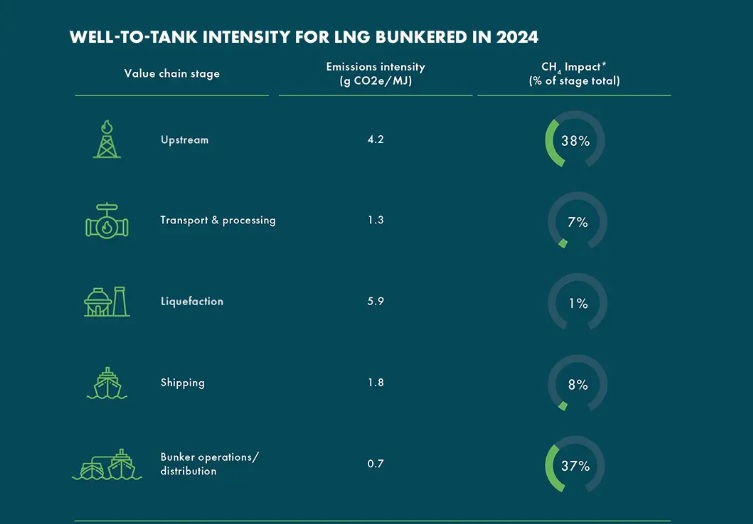
The study analyses emissions originating from the five key fuel lifecycle stages of LNG: upstream, transportation & processing, liquefaction, shipping, and distribution & bunkering operations. It aligns with the International Maritime Organization’s (IMO) WtT lifecycle analysis guidelines, the Intergovernmental Panel on Climate Change’s (IPCC) AR5 GHG definitions, and is based on asset-specific 2024 data.
With the transition from fossil fuels in its early stages across most industry sectors, including maritime, around 95% of vessels are still powered by oil-based marine fuels. LNG is the only viable option available at scale at a commercially competitive price. Consequently, it represents the leading alternative and already accounts for nearly 20% of the vessel orderbook. As the industry transitions toward net-zero and prepares for a rapidly expanding fleet of LNG-fueled vessels, understanding the real-world lifecycle emissions of LNG is critical to shaping effective regulation and guiding future investment decisions.