
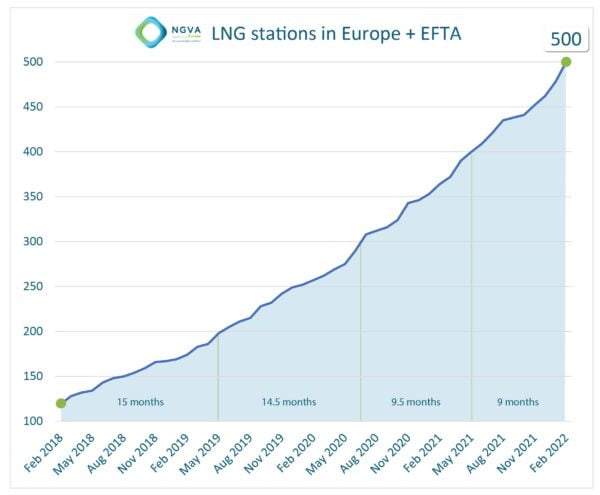
February 9, 2022. Europe has reached the milestone of 500 liquefied natural gas (LNG) filling stations. This number was published in the publicly available station map of the Natural & bio Gas Vehicle Association (NGVA Europe) and includes data of the European Free Trade Association (EFTA) countries. While growing exponentially, the size of this fueling network doubled within only 2 years.
Today, the countries with the highest amount of stations are Italy with 112, Germany with 108, Spain with 79, and France with 60 LNG stations. With a plus of 140% within only one year, Germany is among the top gainers (coming from 45 stations in February 2021). In the same period of time, Italy gained 35% (from 83), Spain 23% (from 64) and France 25% (from 48) new stations.
This huge gain is reflected in equivalent LNG vehicle registration numbers which are expected to be released this spring.
NGVA Europe’s Secretary General Dr Jens Andersen commented: “We are proud to have reached this important milestone of 500 LNG stations in Europe. It is the proof that LNG as a vehicle fuel is both widely accepted, and also available.
An exponentially growing amount of consumers are choosing LNG as a future proof transport fuel for which vehicles are largely available, affordable, and most importantly, potent enablers of a drastic reduction in GHG emissions.
This is because the ‘N’ in LNG could be easily replaced with ‘R’ as there has been an increasing share of ‘R’enewable gas in its fuel mix – bio-LNG.
Therefore, upcoming legislation must establish a much-needed holistic and technologically neutral framework to i) account for the contribution of renewable and low-carbon fuels when assessing overall emissions of a vehicle, and ii) keep supporting the further deployment of LNG refueling infrastructure across the EU which is needed for increasing the uptake of bio-LNG.”