
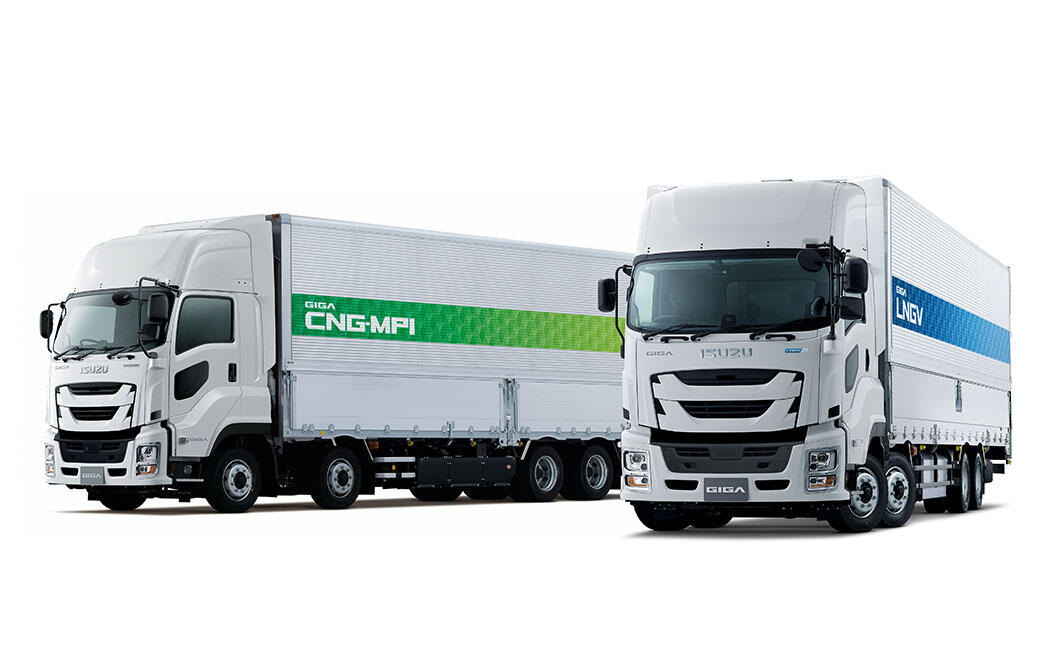
October 16, 2025. Isuzu Motors Limited has launched upgraded versions of heavy-duty GIGA LNG and GIGA CNG trucks.
The upgrades combine outstanding environmental performance unique to liquefied natural gas (LNG) and compressed natural gas (CNG) models with enhanced safety features.
Isuzu is the only automaker in Japan that manufactures and sells trucks fueled by natural gas. For almost 30 years, the company has been committed to promoting natural gas vehicles to reduce environmental impacts and enhance energy security. Combining outstanding environmental performance with the same level of usability demonstrated by diesel vehicles, Isuzu believes the GIGA LNG and GIGA CNG trucks can play a significant role in the transition to a carbon-neutral society.
Compared to diesel vehicles, natural gas-powered GIGA LNG and GIGA CNG trucks emit extremely low levels of PM and NOx, which are major causes of air pollution, thereby reducing environmental impact. In particular, being a liquid fuel, LNG vehicles can be refilled nearly as quickly as diesel ones. Coupled with its high fuel loading, LNG trucks allow for longer traveling distances, with ranges exceeding 1,000 km.
GIGA LNG and GIGA CNG vehicles can run on biomethane or e-methane. To date, these vehicles have been used in various pilot projects involving carbon-neutral gas, confirming they can operate smoothly without any modifications required. As carbon-neutral gas become more commonplace, these vehicles are poised to contribute to low-carbon and decarbonization goals in the near future.
Isuzu will deploy its EDSS system, currently installed in diesel vehicles, to LNG and CNG vehicles as well. When the Driver Status Monitor (DSM) camera detects a hazard or when the driver manually activates the EDSS switch, the system automatically begins applying the brakes, gradually slowing the vehicle to a stop.
When the EDSS is activated, it notifies the driver via warning messages on the multi-information display and sound alerts. Outside the vehicle, it alerts others to the hazardous situation by honking, and flashing hazard and brake lights. It also sends email notifications to pre-set email addresses, to enable prompt notice of the situation.