

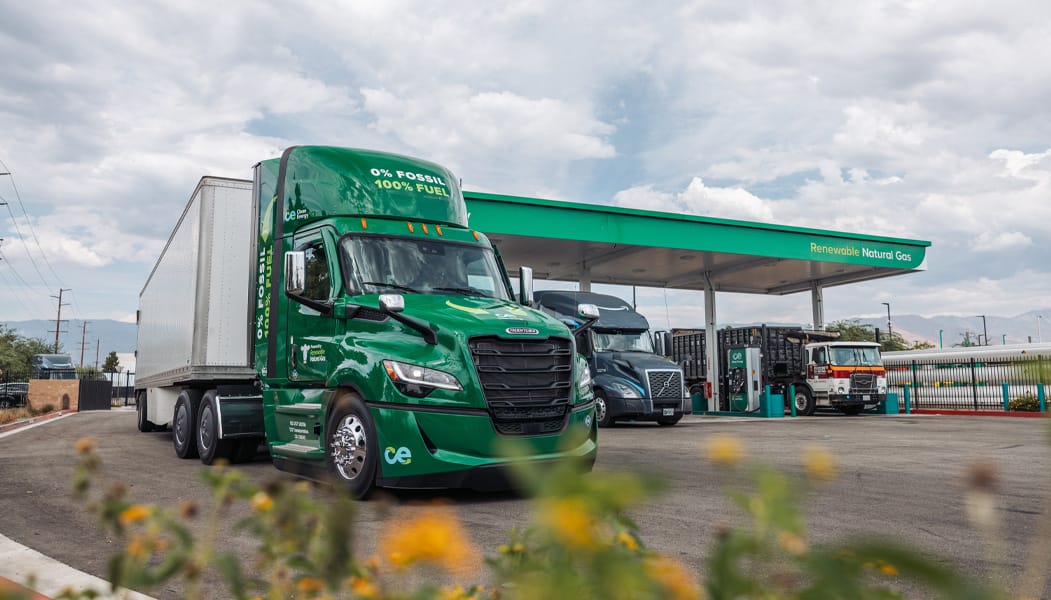
July 4, 2026. Last calendar year marked the sixth consecutive year that commercial fleets in the U.S. state of California fueled by Bio-CNG achieved a carbon-negative transportation outcome, according to a report released by The Transport Project (TTP), RNG Coalition, and California Renewable Transportation Alliance (CRTA).
Renewable natural gas (RNG) accounted for 98% of all on-road fuel used in natural gas vehicles in California in 2025, driven by the state’s successful Low Carbon Fuel Standard (LCFS) program. According to data from the California Air Resources Board (CARB) the annual average carbon intensity score of Bio-CNG in that mix was -198.32 gCO2e/MJ.
In fact, Bio-CNG holds the lowest average carbon intensity of any clean fuel option on California’s roadways today and is the only fuel producing a negative carbon intensity fleet outcome in the California Low Carbon Fuel Standard (LCFS) Program, which includes ethanol, biodiesel, renewable diesel, Bio-CNG, Bio-LNG, electricity, alternative jet fuel, and hydrogen.
Even more, while RNG made up just 6% of all on-road alternative fuels dispensed by volume under the California LCFS in 2025, it generated 25.3% of all carbon dioxide equivalent (CO2e) emission reductions of on-road alternative fuels reported.
The groups report that in 2025 a total of 227.83 million gallons (DGE) of natural gas were used as motor fuel in the state. Of that, 222.71 million gallons (DGE) were from renewable sources. Even more, 21.9% of all RNG motor fuel used in-state was produced in-state, up from just 6.74% in 2021, and the overwhelming majority is from agricultural operations.
In addition to their negative greenhouse gas (GHG) emissions, ultra-low NOx medium- and heavy-duty RNG-fueled trucks and buses perform at levels that are 90% below the federal nitrogen oxide (NOx) standard and 90% below the federal particulate matter (PM 2.5) standard. NGVs virtually eliminate criteria pollutant emissions that contribute to asthma, heart disease, and poor air quality.
Investing in RNG-fueled trucks and buses provides policymakers the most cost-effective way to achieve significant emissions reductions from commercial transportation sources today.
More information in www.usgasvehicles.com