
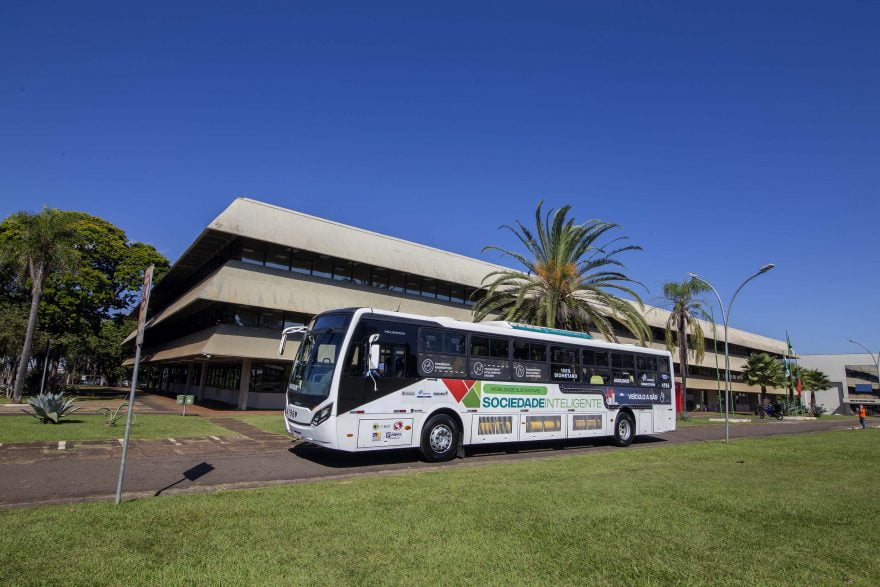
June 7, 2023. Londrina enters the history of sustainable urban mobility as the first city in Brazil to test an urban bus that runs on 100% biomethane. The bus will be incorporated by the Municipal Transit and Urbanization Company (CMTU) to the public transport of the town, to go through a period of analysis.
The initiative is from the Municipality of Londrina, together with the Companhia Paranaense de Gás (Compagas), and in partnership with the company Scania. The objective is to seek environmentally correct urban mobility, in line with the sustainability objectives of the United Nations (UN). This is because biomethane, which is a gaseous biofuel extracted from biogas processing, emits 90% less carbon dioxide (CO2) into the atmosphere, the gas that most contributes to global warming.
The CMTU-incorporated bus will be tested for about a month, from June 12 to July 14. During the evaluation period, the supply of biomethane will be carried out by Gastech. That month, the bus will be used on four different lines operated by the concessionaire Transportes Colectivos Grande Londrina (TCGL).
The intention is that, once the effectiveness of the technology has been demonstrated, similar and more sustainable vehicles will become part of the public transport fleet of the municipality in the future, with the aim of contributing to a cleaner and smarter city. Currently, Londrina transports an average of 2,200,000 passengers each month.
According to the Mayor, Marcelo Belinati, it is the most sustainable city in Paraná and the second in southern Brazil. For him, there is no doubt that this initiative will be exported to various locations in the country and even the world. “Biomethane reduces pollutant emissions into the atmosphere by up to 90%, a cubic meter costs about half the price of diesel, and we are the first city in Brazil where this test will be carried out on a regular line with passengers. After the evaluation period, in a second step, we will analyze the results to evaluate the effectiveness and possible implementation in the city. At the same time, we are working so that our Waste Treatment Center (CTR) can begin to produce gas and thus protect the environment and make the city even more sustainable”, he said.