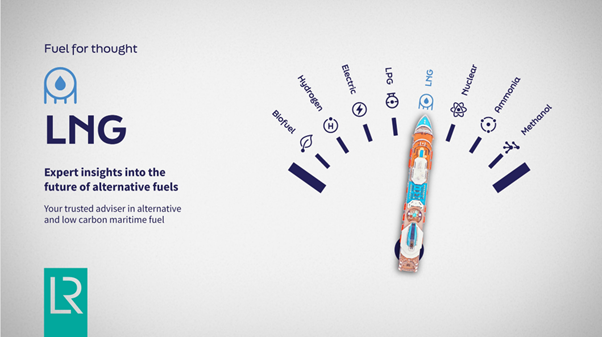
May 10, 2026. Lloyd’s Register (LR) has released its latest Fuel for thought: LNG report, offering a refreshed and data-driven assessment of LNG’s evolving role as a mature and significant fuel in transition for the shipping industry.
As of March 2026, the dual-fuel LNG fleet has reached 1,665 vessels, with an additional 982 on order — expanding the gas-fueled fleet. Although recent developments may have created uncertainty that has impacted investment in alternative fuels, LNG continues to be the key alternative fuel in the existing orderbook.
Growth is being driven particularly by the container sector, which is on course to more than double its LNG capable fleet, while cruise, tanker and PCC/RoRo operators are also accelerating their uptake.
LR’s economic modeling confirms LNG remains the most cost-effective alternative fuel pathway to 2050 under any proposed framework so far.
The report also shows that blending LNG with Bio-LNG and e-LNG could strengthen this advantage further, allowing LNG-fueled vessels to generate compliance surpluses in the early years of new regulatory regimes.
A major focus of the updated report is the significant progress in methane slip reduction. High-pressure two-stroke engines are now achieving slip as low as 0.2 g/kWh, while low-pressure engines fitted with exhaust gas recirculation are delivering reductions of more than 60%.
However, these improvements are not yet reflected in the emissions factors under both FuelEU Maritime and the IMO’s Lifecycle Assessment guidelines. The report argues that updating these factors will be essential to ensure that regulation reflects current technology and incentivizes genuine emissions reductions rather than penalising early movers.
The report also underlines the importance of upstream emissions and fuel certification. Cleaner LNG production, reduced methane leakage and the growth of independently verified certification schemes are essential if shipowners are to realize the full emissions reduction potential of cleaner supply chains.