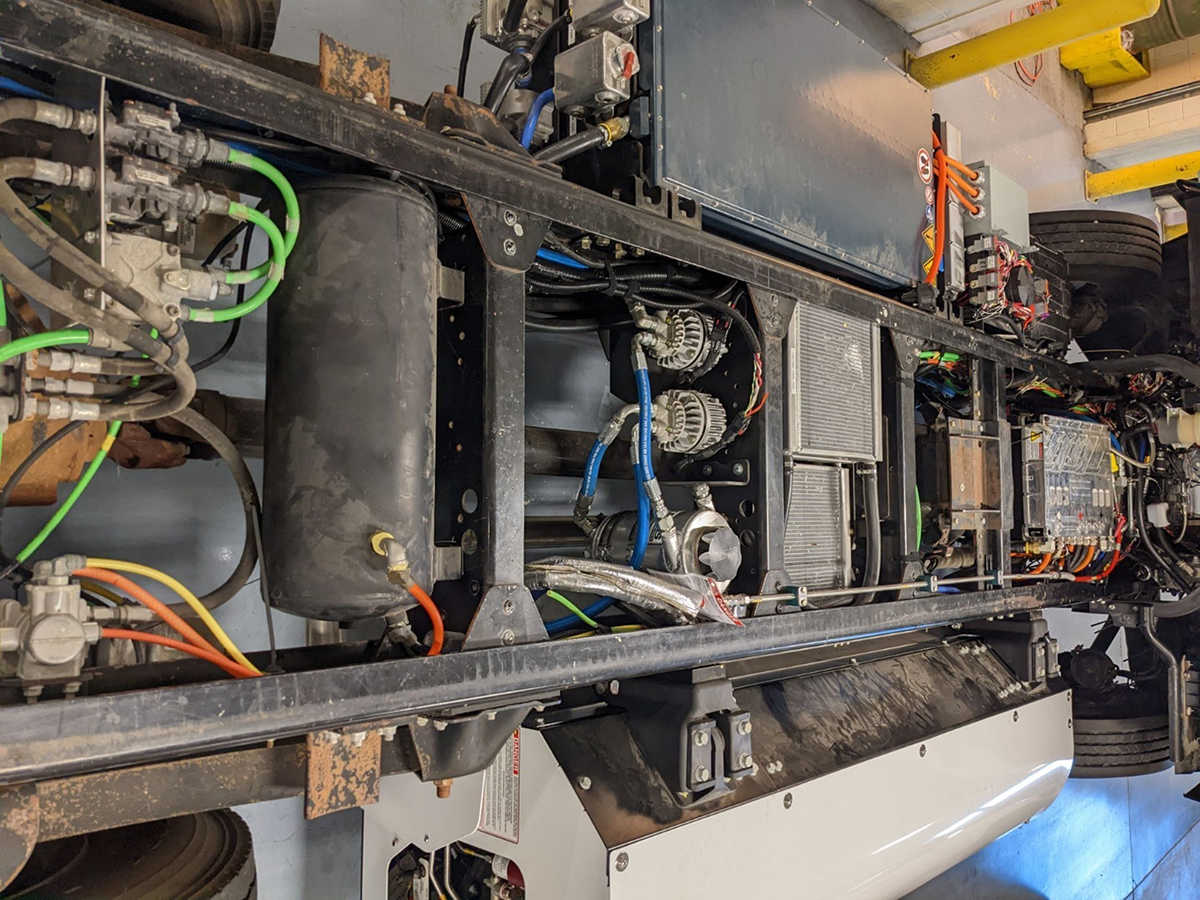
March 9, 2024. Southwest Research Institute (SwRI) has developed a natural-gas-fueled medium-duty truck outfitted with a hybrid powertrain that achieved a 25% reduction in greenhouse gas emissions (GHG) over standard diesel powertrains. The vehicle uses an SwRI-designed, spark-ignited natural gas engine coupled with a hybrid powertrain and a 40-kilowatt-hour battery pack.
The project was awarded by the National Renewable Energy Laboratory (NREL) in 2021 as part of a larger $11 million program to promote the development of advanced natural gas vehicle technologies. Isuzu Motors, Woodward Inc. and South Coast Air Quality Management District (SCAQMD) also collaborated on, and helped fund, the project.
Using a commercially available medium-duty diesel truck as a baseline for fuel economy and carbon dioxide emissions, the team aimed to develop a new natural gas engine/hybrid powertrain to achieve the best balance of fuel consumption, energy savings, air quality improvement and total cost of ownership.
“The problem with most natural gas engines is that they are usually derived from a diesel engine platform that has been highly optimized for burning diesel fuel,” said Ryan Williams, Manager of the spark-ignited engine section in SwRI’s Powertrain Engineering Division. “For this program, our team completely redesigned the cylinder head around a modern gasoline engine better suited for natural gas. This design approach produced much faster combustion, which opened new pathways for higher efficiency.”
“Our engine runs as efficiently as a conventional diesel engine, but it produces 12% less carbon dioxide due to the lower carbon content of the natural gas fuel,” Williams said. “The addition of the hybrid powertrain allows us to turn off the engine for large portions of the operating cycle for additional CO2 reductions. We have shown a 25% reduction in GHG emissions under typical city driving conditions.”
In addition to the greenhouse gas reductions, the program also targeted a significant reduction in tailpipe NOx emissions. Current regulations limit total NOx emissions to 0.2 grams per horsepower-hour, but future regulations to be phased in by 2027 will require 80-90% reductions. Using a standard three-way catalyst, the vehicle demonstrated compliance with the most stringent standard of 0.02 g/hp-hr.
More information in www.usgasvehicles.com